HYDROGEN education
Hydrogen is a clean energy carrier and industrial input that can store energy, fuel transportation, support manufacturing, and provide backup power when produced responsibly.
RHA’s hydrogen educational resources page serves as your one-stop shop for all things renewable hydrogen and Pacific Northwest hydrogen policy.
Whether you’re just looking to get some hydrogen 101 or are trying to stay current on the latest renewable hydrogen industry updates, RHA is your partner for clear, accessible information on the hydrogen industry.

HYDROGEN 101
What is hydrogen?
Hydrogen is the most abundant element in the universe, and in its purest form is an odorless, colorless, tasteless, non-toxic, non-poisonous gas.
Hydrogen is used as a clean fuel or industrial input and has been used for decades in commercial and industrial applications across the global economy.
Hydrogen and other clean fuels matter today because they can do things electricity alone cannot. Hydrogen can store energy for long periods, fuel heavy equipment, support high-heat industry, and provide power during outages. These roles are becoming more important as grids face higher demand, weather risk, and supply limits.
What is renewable hydrogen?
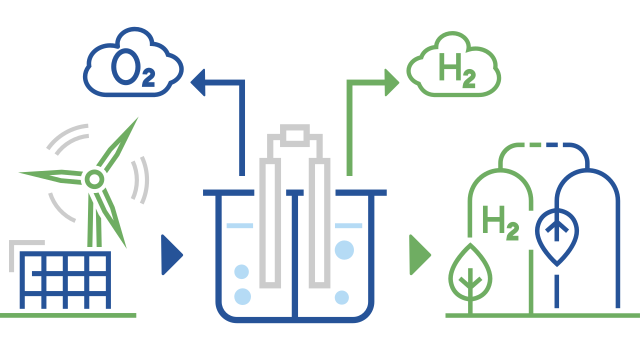
Renewable hydrogen is hydrogen produced using renewable energy and renewable feedstocks, as defined in Oregon and Washington state law.
Renewable hydrogen can be produced in several ways, including:
- Electrolysis, using renewable electricity to split water into hydrogen and oxygen
- Organic and waste-based pathways, where hydrogen is separated from renewable or waste-derived materials
Why do we need renewable hydrogen?
Renewable hydrogen is most useful where electricity alone is not enough, or where reliability, fuel density, or long operating hours matter. In most regions, these energy needs occur in transportation, energy, and industrial end uses.
RHA focuses on the following applications with community partners:


Transportation
Industrial
Energy Resilience
- Heavy-duty, high uptime, and long-route vehicles (cars, trucks, buses, etc.)
- Forklifts, tractors, and other off-road vehicles
- Planes, trains, and watercraft
- High-heat processes (glass, steel, concrete)
- Chemical processes (refining, fertilizer)
- Derivative fuels (SAF, methanol, ammonia)
- Seasonal storage of renewable energy
- Peak demand management
- Microgrids and backup power
- Local energy production
Applications for hydrogen extend beyond the common use cases above, including aerospace, nuclear power, and laboratories.

Frequently Asked Questions About Renewable Hydrogen
Is hydrogen safe?
The U.S. currently produces ten million metric tons of hydrogen annually. As with other gases—natural gas and propane—safety precautions for hydrogen have been in place for decades. Hydrogen’s properties include having a wide flammability range, being non-toxic, colorless, and odorless—all of which are factors in how hydrogen handling systems are designed. Higher pressures in hydrogen vehicles and fueling stations call for enhanced safety precautions, such as communication from the vehicle to the station, along with sensitive leak detection and monitoring. Tens of thousands of fills have safely taken place over the past 15+ years.
Hydrogen, like all fuels, presents inherent hazards that must be understood and managed. Key safety considerations include:
- Flammability: A wide flammability range in air and very low ignition energy, meaning it can ignite more easily than many common fuels.
- Leak potential: A small molecular size that allows hydrogen to escape through small openings and fittings more readily than other gases.
- High stored energy: When compressed or stored as a cryogenic liquid, hydrogen systems contain significant energy that must be properly controlled.
- Invisible flame: Hydrogen flames can be nearly invisible in daylight and emit low radiant heat, complicating detection.
- Material effects: In certain conditions, hydrogen can cause embrittlement in metals and degradation in some polymers.
Importantly, hydrogen is not new. It has been used safely in industrial applications for over a century, supported by established engineering practices, operational controls, and regulatory frameworks. What is new is its expansion into broader energy, transportation, and distributed applications, bringing hydrogen into environments and communities that may be less familiar with its properties.
Mitigation strategies already exists to manage these risks, including:
- Hazard analysis: Conducting thorough risk assessments early in design and throughout operations.
- Proper siting and separation distances: Locating equipment to reduce exposure to people and adjacent infrastructure.
- Ventilation: Designing systems to prevent hydrogen accumulation and keep concentrations below flammable limits.
- Leak detection: Installing fixed and portable gas detectors, along with pressure and flow monitoring systems.
- Flame detection: Using UV/IR or infrared technologies to identify otherwise hard-to-see hydrogen flames.
- Emergency shutdown and isolation: Incorporating automatic systems to stop flow and limit release duration.
- Material selection: Choosing metals and polymers compatible with hydrogen service to prevent embrittlement and degradation.
- Codes, standards, and training: Applying established regulatory frameworks and ensuring operators and first responders are properly trained.
Hydrogen’s properties should be respected, but not feared. Every fuel carries inherent risks, and society has learned to manage those risks through thoughtful design, robust regulation, and operational experience. Hydrogen requires specific controls tailored to its unique characteristics, yet its behavior is well understood and can be managed effectively with a rigorous, engineering-based approach. Clear communication, knowledge sharing, and a strong safety culture are essential to ensuring that isolated incidents do not distort public perception or hinder progress.
There are many online and training resources available to help those working with hydrogen. A few highlighted examples include:
- H2Tools.org – A resource from the U.S. Department of Energy and Pacific Northwest National Laboratory offering data, incident lessons learned, technical references, and safety planning tools.
- Hydrogen Safety Considerations for California – A hydrogen safety report for the public and policymakers reviewing key safety considerations across various hydrogen production methods and applications.
- Hydrogen Safety Panel – Offers contracted expert reviews of hydrogen installations and emerging safety issues.
- Center for Hydrogen Safety eLearnings, Webinars, and Fundamentals of Hydrogen Safety Credential – A series of educational resources for those looking to boost their fundamental knowledge of hydrogen safety.
How is renewable hydrogen different from fossil-based hydrogen?
Renewable hydrogen is produced using renewable energy sources, while fossil-based hydrogen is produced using fossil fuels.
The industry is transitioning away from the “color wheel” for labeling various production pathways using a methodology that focuses on carbon intensity metrics. The U.S. Department of Energy (DOE) developed the GREET® (Greenhouse gases, Regulated Emissions, and Energy use in Technologies) life cycle analysis to assess the environmental impacts associated with hydrogen production.
Is hydrogen an energy source or an energy carrier?
Hydrogen is an energy carrier. Hydrogen must be produced from another substance. Hydrogen can be produced—or separated—from a different source, for example, from water or biomass, and used as a source of energy or fuel.
Where does hydrogen make the most sense today?
Hydrogen and other clean fuels matter today because they can do things electricity alone cannot. Hydrogen can store energy for long periods, fuel heavy equipment, support high-heat industry, and provide power during outages. These roles are becoming more important as grids face higher demand, weather risk, and supply limits.
How much water does hydrogen use?
Renewable hydrogen production uses modest amounts of water compared with other fuels. Roughly four gallons of water are needed to make a kilogram of hydrogen, and about half the water is used to create an equivalent amount of gasoline for transportation.
One-half to two-thirds of the water used in production is regenerated when hydrogen is consumed at the point of use and released as pure water through vehicle tailpipes or collection systems.
Why is hydrogen discussed alongside clean fuels?
Hydrogen can be used as a clean fuel, replacing fossil fuels in the transportation or backup energy sectors. Hydrogen can also be used as an ingredient to produce other clean fuels, such as renewable diesel and sustainable aviation fuels.
Why does renewable hydrogen require policy?
While hydrogen is a commercially mature product with decades of industrial and commercial use, many renewable hydrogen technologies are still under development. This means that technology costs are higher today than what is expected when technologies reach scale. It also means many technology solution providers are still innovating and improving their products.
Like other emerging energy technologies, renewable hydrogen is expected to be cost-competitive with legacy fuels as scale and technology maturation reduce costs for end users. In the meantime, policy can help to reduce cost for end users, encourage business investment, and coordinate regional market growth.
This means that renewable hydrogen technology and market development still has the potential to be heavily influenced by policy. Federal, state, and local policy can help to encourage local hydrogen projects and innovation, or it can create additional challenges for new technologies.
The upside for state and local governments is clear: renewable hydrogen is expected to be a trillion-dollar global market by 2030. Renewable hydrogen projects represent jobs, growth of local tax base, and increased fuel security and resilience.
State Energy Policy Powers Demand-Based Growth
State and local governments can attract renewable hydrogen businesses and local jobs through a coordinated policy program. Washington and Oregon have adopted state policies that help to encourage hydrogen production and usage.
Washington
- SB 1409 (2025) – Clean Fuels Program Update
- HB 1216 (2023) – PEIS for Green Hydrogen
- HB 1236 (2023) – Transit Hydrogen Production Authority
- SB 5447 (2023) – Alternative Jet Fuel
- HB 1988 (2023) – Hydrogen Manufacturing Incentives
- SB 5910 (2022) – Renewable Hydrogen Definition
- SB 5126 (2021) – Climate Commitment Act
- SB 5811 (2020) – ZEV Standards
- SB 5116 (2019) – Clean Energy Transition Act
- SB 5588 (2019) – PUD Hydrogen Sale Authority
Oregon
- SB 685 (2025) – Hydrogen Transparency
- HB 2530 (2023) – Renewable Hydrogen Definition
- EO 20-04 (2020) – Climate Protection Program
- SB 1044 (2019) – ZEV Targets
- SB 98 (2019) – Renewable Hydrogen and RNG
- HB 2186 (2009) – Oregon Clean Fuels Program
Reports
Hidden Hydrogen
Electrolyzer Evolution
Unlocking Electrolytic Hydrogen
RHA Blogs
Unlocking the Pacific Northwest’s Hydrogen Potential: Electrolyzer Innovation and R&D
RHA Blog Unlocking the Pacific Northwest’s Hydrogen Potential: Electrolyzer Innovation and R&D Author: Adam Merah, Nel Hydrogen, RHA Board Member 6 min read | Wallingford,
What Really Drives the Cost of Hydrogen Refueling Stations?
RHA Blog What Really Drives the Cost of Hydrogen Refueling Stations? Author: Gildas Bonnier, Co-Founder, Grove Hydrogen Solutions The price of hydrogen molecules matters. But
Where Grid Planners Get Hydrogen and Long-Duration Energy Storage Wrong
RHA Blog Where Grid Planners Get Hydrogen and Long-Duration Energy Storage Wrong and How to Properly Value an Electrolyzer Author: Devin Gaby, Customized Energy Solutions
Renewable Hydrogen for Integrating Wind and Solar
RHA Blog Renewable Hydrogen for Integrating Wind and Solar Author: RHA Founder Ken Dragoon About the Author Producing hydrogen from renewable electricity (electrolysis) can provide
Symbiosis on the Savanna: What a Black Rhino Can Teach Us About Electrolyzers and the Grid
RHA Blog Symbiosis on the Savanna: What a Black Rhino Can Teach Us About Flexible Electrolyzers and the Grid Author: RHA Board Member Matthew Klippenstein
Additional Hydrogen Resources
PNW Renewable Hydrogen Market Outlook
- Pacific Northwest Low-Carbon Hydrogen Analysis (2025)
- PNNL and Sandia Hydrogen Transportation and Distributed Energy Systems Seismic Risk Assessment for Cascadia Subduction Zone Airport Facilities (2025)
- PNNL and Sandia Quantitative Risk Assessment for Fuel Cell Electric Bus Hydrogen Storage and Refueling Facility (2025)
Renewable Hydrogen Policy Resources
- WA Ecology Programmatic Environmental Impact Statement for Green Hydrogen Energy Facilities in Washington State (2025)
- WA Commerce EJ Toolkit for H2 Developers (2025)
- OR Dept of Energy Strategy (2025)
- WA Commerce Green Electrolytic Hydrogen and Renewable Fuels (2024)
- OR Dept of Energy Renewable Hydrogen in Oregon (2021)
Hydrogen Podcasts
RHA Newsletter Archive
Newsletter Archive
2025
- December 2025
- October 2025
- September 2025
- July 2025
- June 2025
- May 2025
- April 2025
- March 2025
- February 2025
2024
- December 2024
- October 2024
- Summer 2024
- June 2024
- May 2024
- April 2024
- March 2024
- February 2024
- January 2024
2023
- November/December 2023
- October 2023
- September 2023
- August 2023
- July 2023
- June 2023
- May 2023
- April 2023
- March 2023
- February 2023
- January 2023
2022
- November/December 2022
- October 2022
- September 2022
- July 2022
- June 2022
- April 2022
- March 2022
- February 2022
- January 2022