RHA Blog
Where Grid Planners Get Hydrogen and Long-Duration Energy Storage Wrong
and How to Properly Value an Electrolyzer
Author: Devin Gaby, Customized Energy Solutions
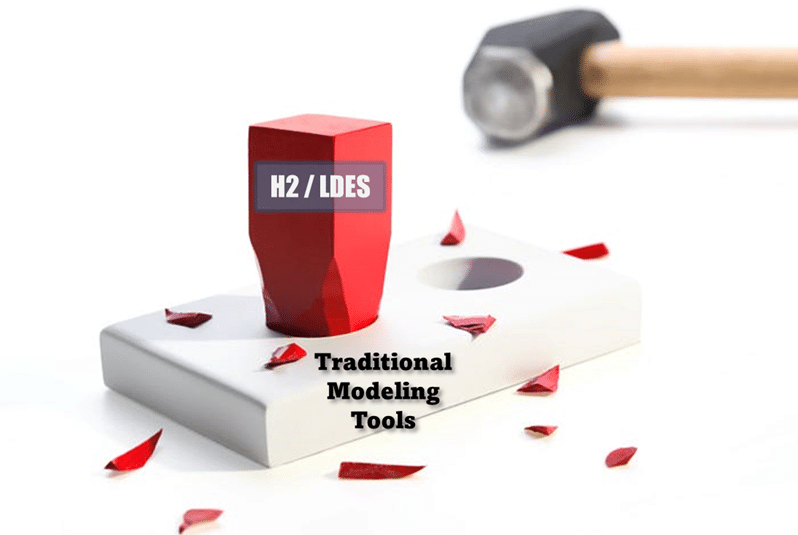
As many grid planners can attest, trying to fit hydrogen and long-duration energy storage (LDES) in a long-term resource plan can sometimes feel like trying to plug a square peg in a round hole. It’s counterintuitive: as the grid continues to transition towards 100 percent clean energy in many regions across the country, the primary challenge grid operators are facing is how to shift excess solar and wind energy from times when demand is low to when the grid is most constrained. Both LDES and hydrogen should be the perfect tools to solve this problem— LDES provides seasonal energy shifting and firm capacity during emergency events, while hydrogen electrolyzers convert excess electricity into a gaseous energy carrier that can support dozens of other energy-hungry industries. But despite the logical applications, planning studies continue to deprioritize these solutions in favor of other expensive, dirty, or unproven technologies.
Why Standard Models Fall Short for LDES
Most capacity expansion models and dispatch optimization tools were designed with a very different class of storage asset in mind: short-duration batteries (4 hours or less) that operate within a predictable intra-day cycle of charge and discharge. While these technologies provide significant benefits to the grid, the value statement differs materially from LDES. This leads to a structural mismatch in how most models represent time and operational flexibility across resource classes.
Modeling storage dispatch requires sub-hourly resolution to accurately account for how short-term variability in wind and solar generation and volatility in energy prices drive charging and discharging behavior. Yet many standard capacity expansion models aggregate time using representative days to simulate months. While short-duration storage can typically overcome this approach because of its predictable daily charge/discharge cycle, LDES operations can vary dramatically depending on grid conditions, meaning a “representative day” model is inadequate.
Resolution is not the only challenge – it also matters how representative periods are linked. Even a full-year model with 52 weekly periods will drastically underestimate LDES value if the optimization is not calculated across the full year. If the optimization is limited to a single day or week (to reduce computational complexity), this prevents energy from being shifted between weeks or months, which is precisely what LDES is designed to do.
Electrolyzers Are Not Recognized for Their Value as a Flexible Load Resource
Grid planners live in a world of supply capacity and peak demand. Rightfully, their primary concern is ensuring that there is sufficient built capacity to provide energy when the system load reaches its peak. Given the critical need the grid provides for health, economy, and human comfort, modelers not only plan for the forecasted peak demand, but also secure additional capacity to cover a Planning Reserve Margin (PRM). The PRM is intended to provide a safety net in case of load forecasting error, generator outage, and/or transmission unavailability. The problem with this approach comes when the PRM is set artificially high because incorrect assumptions are made about how certain types of load behave, which can lead to an overbuilt, overly expensive grid.
Flexible load resources are loads that can modify their demand based on price incentives or grid signals. Battery storage resources are a perfect example—these assets will charge when energy prices are low, temporarily becoming a load for the system. But when prices rise, they flip from charging to discharging, reducing the load on the grid and even providing energy. Most grid operators have incorporated this logic for short-duration storage modeling, but have not extended it to hydrogen.
Hydrogen electrolyzers provide similar value but are often not recognized as such. Many electrolyzer technologies, such as proton exchange membrane (PEM) systems, are uniquely capable of adjusting power consumption in real time. The ramping flexibility of PEM electrolyzers provides significant value to the grid for system stability and load shedding, assuming the correct rate plans are in place to incentivize responses to price signals over maximum hydrogen production. CES and RHA recently showed in a joint report that electrolyzers can operate profitably between a 79 to 95 percent capacity factor and completely reduce grid energy consumption during peak hours by relying on co-located solar energy during those times. If a utility implements rates that incentivize or enforce reduced production during peak hours, then the grid planners can remove electrolyzer load from the PRM, resulting in less capacity build-out and cost savings for customers.
Maximizing Revenue: The Multi-Market Opportunity
Electroyzers and LDES have value on their own, but they can truly excel when co-located with other resources to synergize capabilities and maximize grid applications. Consider an electrolyzer paired with solar and battery storage. Adding these resources multiplies the number of potential revenue streams available for the asset—assuming it is being modeled correctly.
When an electrolyzer is modeled with the right temporal resolution, a sufficient optimization horizon, and a dynamic load profile that reacts to price signals, a much richer picture of revenue potential emerges. When our team at CES uses its proprietary CoMETS (Comprehensive Market Evaluation Tools) platform to simulate flexible operations of an electrolyzer paired with solar+storage, the value is maximized. The table below outlines the primary revenue streams available depending on the market, along with the modeling considerations relevant to each:
Table 1. Electrolyzer revenue streams, relevant optimization horizons, and key modeling considerations.
| Revenue Stream | Optimization Horizon | Participation Strategy for Electrolyzer Paired with Solar+Storage |
|---|---|---|
| Energy Arbitrage | Day-ahead / Real-time |
|
| Ancillary Services | Day-ahead / Real-time |
|
| Capacity Market | Monthly / Annual / Multi-year |
|
| Hydrogen Commodity Sales | Monthly / Annual |
|
| Transmission Deferral | Long-term planning |
|
The interactions between these revenue streams — particularly the opportunity cost trade-offs between reserving capacity for ancillary services versus deploying it for energy arbitrage — are complex and highly time-dependent. Getting them right requires a co-optimization framework that can evaluate these trade-offs simultaneously across the relevant horizon, not sequentially across separate models.
Key Recommendations for Grid Modelers and Developers
If the US ever hopes to achieve 100 percent net zero, it will require all forms of carbon-free technologies to get there, including LDES and hydrogen. But the technologies can’t be built unless grid planners capture the system benefits and developers are able to show their investors the full revenue opportunity. Based on the modeling gaps discussed above, here are the highest-priority actions for anyone developing, operating, or evaluating LDES and electrolyzer assets:
- Use linked representative periods, not isolated snapshots. Any planning model that treats time periods as independent silos will undervalue LDES. Ensure your model allows energy to transfer between representative periods.
- Match the optimization horizon to the value driver. Day-ahead models are sufficient for short-duration batteries. LDES requires extended horizons — from multi-day rolling windows to full-year optimization — depending on the primary use case.
- Demand that hydrogen electrolyzers be modeled as flexible loads. Failure to do so will overestimate the impact on the grid, leading to more expensive investments for utilities. For electrolyzer developers, this will also mean more expensive interconnection costs if the utility/ISO assumes your project will press the grid at the worst times.
- Co-optimize across revenue streams. Single-market optimization leaves money on the table. Use market-tested tools like CES’s CoMETS platform for a co-optimization framework that simultaneously evaluates energy, ancillary services, capacity markets, and demand response.
About the Author
Devin Gaby – Associate Director, Customized Energy Solutions (CES)
Devin leads strategic consulting and advisory services in CAISO and the Western US in CES’s Consulting practice. He supports clients through quantitative analyses of energy storage development, market strategy consulting, and modeling of emerging technologies like green hydrogen and LDES.
CES is a global energy services and technology company, founded in 1998 and headquartered in Philadelphia, USA. With over 350 professionals and offices in North America, India, and Japan, CES supports clients worldwide in navigating dynamic, deregulated electricity and energy markets. CES delivers expertise in market consulting, asset management, retail operations, and emerging technologies.